

Slipping the boundaries
On the struggle to overcome systems that divide and shape us, even in intimate ways (& the writer's predisposition for the telling detail).
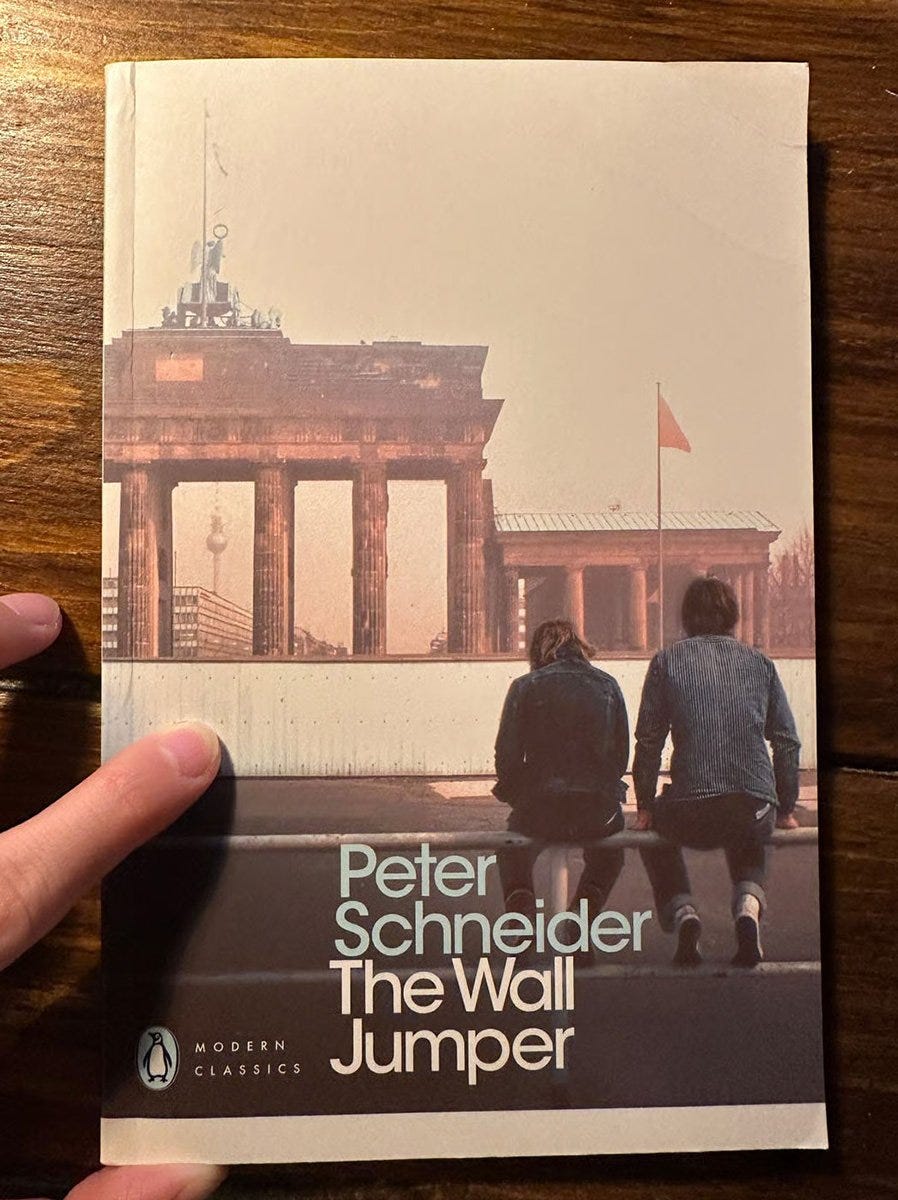
“Having come to distrust the hastily adopted identity that both states offer him, he feels at home only on the border.”
I wonder if every newcomer to Berlin suffers, initially, from the same affliction: a tendency to attribute certain cultural characteristics to east and west Germany, even if they no longer exist as capitalised entities. It feels like the long shadows of the Cold War (1945-1991), immortalised in so many films and books—seemingly defining and so, inadvertently clichéd—still looms large over any visitor’s experience of the once divided city.
Reading the late Peter Schneider’s The Wall Jumper (1982), some five years after my first acquaintance with Berlin in 2019, so long after the fall of the Wall, I recognised my younger self in this enamoured naïveté, and what Schneider’s protagonist describes as “the stupidity of first impressions”—but also, the cautionary mental reins that soon strain to hold it in check. When suppositions appear to come to readily, too neatly, a natural scepticism begins to creep in, casting a healthy dose of doubt on one’s powers of deduction.
The novel’s unnamed narrator is—like Schneider was—a journalist from West Germany. When we meet him he has been living in West Berlin for some two decades, having moved there soon after the German Democratic Republic (GDR, or DDR in German) began building the Wall on 13 August 1961—in part because it was an opportunity to escape military service. The West Berlin authorities had waived the draft to attract people to live in its enclave: bounded by East Berlin on the right and in any case entirely surrounded by the enemy DDR. As Ian McEwan wrote in his excellent foreword to the book, this was why Nikita Khruschev had so vividly described the city as the “testicles of the West”: “When I want the West to scream, I squeeze on Berlin.”
When our curious narrator makes his forays into East Berlin, he is on a mission to write something about the Wall: he is looking for stories. Understandably then, he is highly attuned to every detail, trying to deduce what’s implicit in them, as writers and journalists can’t help but do. In one scene, while riding a taxi, he notices that the ‘VW’ insignia has been removed from every VW Golf he passes. His guess: “that they were taken off before delivery to eliminate free advertising for the West German company.” But immediately, he rejects his first guess, for he knows that he is not an unbiased observer: “I suspect motives where there are only material flaws, centralized command in a simple case of collectors’ mania.”
How many times have I rooted through the same ritual upon landing in any country new to me or when beginning to report a story? This constant supposing and questioning to try to understand an unfamiliar place or subject, armed with only the most essential facts about a place but with the conceit that with enough noticing and listening and paying attention one will eventually figure out the real, underlying picture—or, at least, come as close to it as possible? In every detail we imagine to be telling, we grasp for an “impression that pushes for generalization”.
This has the potential to become a little more pernicious when individuals are subjected to the same blunt scrutiny. Once, while sitting in a cafe along the Kurfürstendamn, West Berlin (which, too, no longer exists as a capitalised entity), the narrator and his East German friend Robert, an emigrant—a defector?—to West Berlin, have an argument about a street riot that breaks out on the boulevard, young people with handkerchiefs knotted across their faces smashing shop windows. Robert remarks triumphantly that the protest must have been set up by the police so that they could use it as an excuse to cordon off the inner city, in order to prevent a real riot—to which the narrator, incredulous, accuses his friend of ascribing far too much omnipotence to the state. To Robert, the narrator thinks, “Everything that happens is preprogrammed, monitored, controlled by invisible hands”.
The quarrel begins when I take what I see at face value; Robert has been trained to read between the lines. Where I perceive merely an event maybe an accident, Robert perceives a plan he has to decipher. A friend who is in my view shy, in Robert’s view is only pretending to be shy. A colleague doesn’t just succeed; he has a formula for success. As Robert sees it, Western society is essentially a well-organized syndicate deliberately kept in a state of disorder by a few people in the know.
Our narrator’s presumptions infuriates Robert, who implores him not to label him too quickly. As our narrator observes: “Nothing else I say can make him quite so mad as the comment that something about him is typically DDR.”
The differing political systems of East and West Germany, defined in opposition to each other, govern their citizens’ lives and shape their psychologies, their interpretations of things: no less than how they see the world. Whenever a point of contention comes up, both sides proffer the same “canned language”, the same “state grammar”, the “lesson dutifully learned”—“true to the states whose influence we no longer recognise”. Robert, the narrator thinks, has a tendency to always lay the blame on something outside himself, “sheltered by a state that takes responsibility for everything”—in implicit contrast, he seems to mean, to West German society: where the assumption is that every every decision, every success, every failure, is one’s own. How well you do, or are seen to do, in life, what you are deemed to deserve, then very much depends on which system you live in, how faithfully you believe in their underlying philosophies. Impossible then, not to wonder, where the state ends and the self begins. Impossible not to wonder, “What would I have become, how would I think, how would I look, if?” One could adhere to the rules of their state; or one could rebel. But either way, they would be reacting to the system they live within, its architecture of politics and feeling.
It’s only human that we do this: read into contextual details to explain how people behave. The trouble is when we fall into the temptation of turning people into symbols, into “political phenomenons”, and treat them merely as such—as if they have no agency to direct their own fates, or that we have no agency to direct our own. It feels important to question not just the influences the ‘other’ lives by but also the influences we ourselves live by, so that we don’t perpetuate our divisions, or give them the air of a fait accompli. People can surprise us, systems can change, and small shifts in one can lead to transformations in the other.
The Berlin Wall fell in 1989. But the themes of Schneider’s novel still feels very relevant to the present day, where the world is so divided into polarised blocs across so many issues: pro-Israel vs. pro-Palestine, Left vs. Right, pro-Russia vs. anti-Russia, Global North vs. Global South, etc.—and yes, as capitalised entities. As our unnamed narrator muses, “It will take us longer to tear down the Wall in our heads than any wrecking company will need for the Wall we can see.” It’s tempting, for the sake of community and strength in numbers, or one’s mere sanity, to cleave to the boundaries set by one side or the other. We’ve seen how such deep divisions cow most people into playing it safe with their opinions, their principles. At a time when history is so weaponised, so Instagrammed, leached of complexity and obscured from any larger context in order to win an argument, it is tempting to seek the shelter of aligning more cohesively with a ‘rightful’ perspective. For instance: at a time when the ‘Western’ powers have been shown to be wearing no clothes, one knee-jerk reaction has been to disavow them on every level, to hold up one’s own hitherto imperfect and equally corruptible small nation as yes, being imperfect, but at least authentic, more human in their imperfections. More often than not, it seems like:
What matters is whether people with whom you wouldn’t want to be identified might make the same observation, not whether it’s true.
Even for the proverbial wall jumpers, things are not straightforward. Though Robert may be comfortable living in West Berlin by its more capitalistic mores—in fact, seems to have mastered aspects of it better than the narrator—he tends to bristle when confronted with criticisms of East Germany, where he grew up. For West Germans, too, any sympathy felt for the other side can lead one to gesture wildly in overcompensation. While visiting Pommerer, an East German acquaintance in East Berlin, to better understand the divided metropolis, our narrator meets a fellow traveller from the West who harbours “the sense of having come from the worst of all possible worlds”, who “tries to override any reference to limitations on life in the East by telling horror stories from the West”.
If the conversation turns to food shortages in the East, she cites figures on the unemployed back home, who see oranges in shop windows and can’t buy them. There may be more housing in the West, but no one can afford it. True, it can take as long as twelve years to receive delivery of a car in the East, but the cars you get so easily in the West clog traffic and pollute the cities. Granted that you can voice criticism in the West, but it has absolutely no effect.
The narrator describes this as a “conversational rite in which the progressive visitor from the West attempts to reconcile his Eastern friend to his situation by showing him that things are even worse in the West”, as a way of commiserating. Within this context, the narrator calls this the “disease of comparison”, where it becomes impossible to take each place on its own terms. Surely, one can’t simply “cure the madness of one state by referring to the madness of the other”?
In the midst of all this, it can feel like the only safe place to live is on the border—not so much ‘sitting on the fence’ so much as being your own person: really thinking about what you believe in and what you stand for, with no concern for which camp might try to claim you for their beliefs, even if you risk finding yourself in awkward, partial agreement with your apparent philosophical enemies.1 Yet, the border can be a lonely place. For those who dwell there, unable to fully embrace their new existence or leave behind their old one, they may never feel the comfort of belonging to any tribe.
But that must be the price to pay, I think, for trying to stay true to oneself, for learning to live according to the map of one’s own creation. Because if, in order to avoid feeling at odds with the world your throw in your lot with one side or another, talk yourself into believing that your inner conflicts are minor, one might end up—as our narrator does with his ex-lover Lena (who, like Robert, is an East German in West Berlin, and whom the narrator seems to deploy as a stand-in for the oppressiveness of the DDR)—losing one’s own compass, slowly absorbing their point of view, learning it “like a foreign language without comprehending its inner structure”.
So, to read?
Yes! For such a slip of a novel it is dense with detail and insights and memorable characters, and as a relative newcomer to Berlin I feel it helps to explain some of its aspects quite profoundly. Schneider brings a journalist’s roving eye and handle on the facts without ever resorting to historical exposition, and only just a few footnotes. The material and logistical realities on both sides of the Wall are folded seamlessly into the characters’ actions and lives, leaving enough ambiguity between what’s factual and what’s exaggerated for you to wonder and Google at what was real and not real. But equally, much of what was real sound sufficiently fantastic that one can’t help but think that the mythologised parts, which in the book often take on a charming allegorical tone, could well have been real too. Definitely one of the books to read to better understand Berlin.
Some years ago, I wrote about another divided city—a still divided city—for the Virginia Quarterly Review: you can read the PDF here.
Below is a newsletter out-take from that trip to Belfast:
Blurred lines of violence, loyalty, and love

"So, sectarianism is less important for my generation. But at the same time, I have been rejected in my romantic pursuits, twice for being Catholic and once for being a unionist. (Laughs.) So, it hasn’t gone away completely yet. But we’re getting there."
Book Notes
Unless a book is very good or very bad, I don’t generally think of books as ‘good’ or ‘bad’. I usually pick up books that purport to answer a question I have, emotional or intellectual, so I genuinely get something almost out of every book I read—which is also why I never rate them on Goodreads: it feels too reductive. But asterix-ed books* I would particularly recommend: whether it’s because the writer writes beautifully, transports a reader completely, tells me something about the world I didn’t know, or simply asks thought-provoking questions.
Current reads:
Peter Schneider’s 2014 book of essays, Berlin Now: The Rise of the City and the Fall of the Wall (translated by Sophie Schlondorff).
I also just got back from from a short trip visiting old friends in London, where I picked up London Falling: A Mysterious Death in a Gilded City and a Family’s Search for Truth (which grew out of this New Yorker story I haven’t read—and if you’re going to pick up the book, maybe don’t read it either!) by Patrick Radden Keefe, whose book Say Nothing: A True Story of Murder and Memory in Northern Ireland and The Snakehead: An Epic Tale of the Chinatown Underworld and the American Dream I loved, and which remain some of my favourite books of literary reportage.
Last finished:
James Baldwin’s Giovanni’s Room*, for the new Chapters bookshop’s Romantic & Ruinous Book Club—my first book club in Berlin. We were invited to take our seats at one of several small tables. Then we were prompted with questions: first discussing in our small groups before sharing collectively with the room. This format, held in the hush of a bookshop after dark, did feel somewhat classroom-like, but it seems like the bookshop was trying out something different that night; a fellow attendee said that usually, everybody sits around joined tables and speaks whenever they want to? Anyway, it felt so rewarding to speak to other readers about a novel I loved—so slim, so electrifying, so much contained within it! Interesting, too, to see how people bring their selves to the material. I, for one, rather identified, with the ‘drifters’ in the book, who seem uncommitted even in their drifting… 😅
Other books read recently:
Inheritocracy: It’s Time to Talk About the Bank of Mum and Dad, Eliza Filby (nonfiction)* – Basically, it’s about how, “If you’ve grown up in the 21st century, your opportunities are increasingly determined by your access to the Bank of Mum and Dad, rather than by what you earn or learn.” I felt like the anecdotes in the book could have gone deeper as ‘case studies’, but I suppose most people would prefer not to share too much about their financial situations. Read this introductory essay by the author (who also writes a newsletter) for an introduction, cribbed from her book. She also talks about it at length with Trevor Noah.
The Little Virtues, Natalia Ginzburg (essays, translated by Dick Davis)* – Really, a necessary manual for living. Found “Portrait of a Friend”, “Human Relationships”, and the concluding essay—from which the book is titled and which considers how we are taught about money from childhood as a ‘little’ virtue arising from instincts of self-preservation rather than a ‘great’ virtue, arising from courage?—particularly thought-provoking.2
Rejection, Tony Tulathimutte (short fiction) – W.C. and I read some of the stories to each other out loud, something I feel this collection lends itself to. Was thoroughly enterained by some of the stories, others exhausted me. I’m sure they were meant to affect a reader exactly so, and consequently, I couldn’t read them in succession—I needed breaks between. Still, the delightful savagery with which Tulathimutte skewers our modern, anxious attempts at connecting, chasing love and sex and anything in between, made me cackle out loud many times despite how bleak some of the stories are. At the same time, I also felt like most of them didn’t edge beyond satire?
All Consuming: Why We Eat the Way We Eat Now, Ruby Tandoh (nonfiction) – Informative, funny read on how food trends came to be, mainly in the UK/US, asking how much our tastes are, in fact, our own? Rhetorical, of course: it’s always been from the people we know and look up to, and more recently, strangers on social media. But also: “So much of our food culture comes down to things like this—the movements of huge companies to create, and the aggressively enforce, a new agenda.” A point I think isn’t appreciated enough.
Good and Evil and Other Stories, Samanta Schweblin (short fiction, translated by Megan McDowell)* – I was first introduced to her story “A Fabulous Animal” in George Saunders’ Storyclub newsletter. It really helped me think through a short story I’m writing, and she has a spot on my ‘Favourite Writers’ list!
All books read since 2023 listed here.
–Emily
Superimposing this onto our present world: I’m thinking of how some people can be leery of veganism, or its variations, because it is also practised, or has been practised, by people they don’t agree with—say, Hindu nationalists, ‘eco-fascists’, maybe Hitler—when there are many sound reasons from an ethical animal-rights, environment, or public-health point of view for being vegan.
I bought a copy from Saint George’s, an English bookstore in Kollwitzkiez, Prenzlauer Berg. I love that when I went to check it out they asked if I would like a secondhand copy, which I’d missed—the shelves are packed! They sell both new and read books, and I hear they buy back books (at a lower price) bought from them too.
The New Yorker story was an insanely good read! However, I haven’t read the book, and not sure if I want to - dubious of what else it could add other than extra filler!! Would be interested in your thoughts how they compare.